
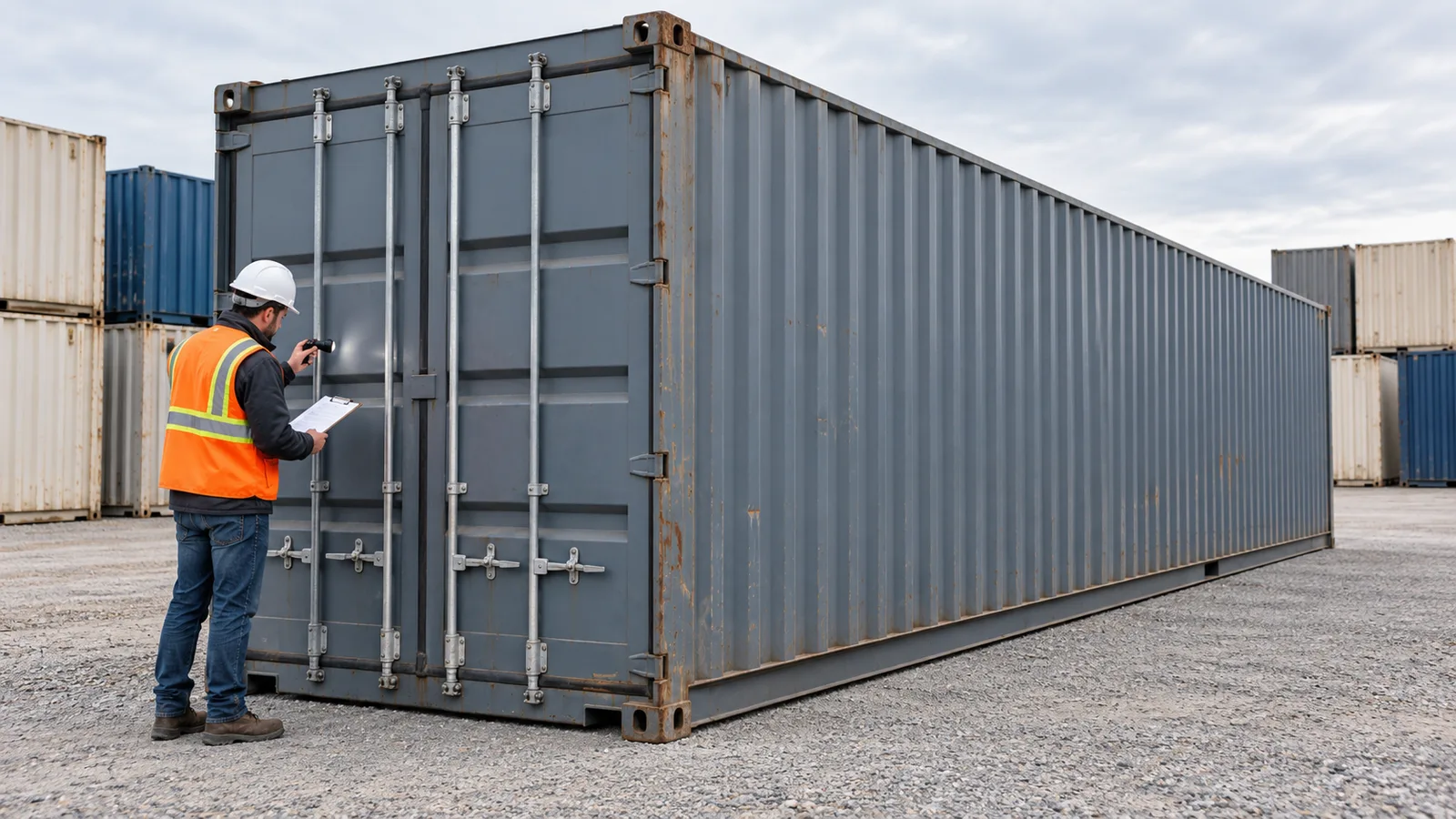

Buying a secondhand container can be a smart way to add secure storage or start a conversion project, but condition labels alone do not tell you whether a specific unit fits your needs. This used shipping container inspection checklist explains how to evaluate the actual container, document what you find, and connect the inspection to delivery, site preparation, and total cost.
The goal is not to find a container with flawless paint. Normal dents, faded color, and surface rust are common after years in service. The important question is whether the box is structurally sound, weather-resistant for its intended use, safe to operate, and accurately represented by the seller. If the container must return to international transport, the requirements are different from those for stationary storage, so state your intended use before requesting a quote.
Used Shipping Container Inspection Checklist at a Glance
Use this order so cosmetic details do not distract you from expensive structural or functional problems:
- Confirm the exact unit, size, type, condition description, and intended use.
- Stand back and check whether the frame appears square and level.
- Inspect corner posts, castings, top and bottom rails, and crossmembers.
- Examine the roof and wall panels for deep dents, holes, and poor repairs.
- Operate both doors and inspect hinges, locking rods, handles, and gaskets.
- Check the interior for daylight, water staining, odor, and contamination.
- Walk the floor and look underneath where it is safe and practical.
- Read the container number, data markings, and CSC plate when relevant.
- Match the container to delivery access and the prepared placement area.
- Get the exact unit, condition, delivery, and included work in writing.
A flashlight, work gloves, phone camera, tape measure, and a copy of the seller’s condition description are useful. Do not climb onto a roof, crawl beneath an unsupported container, close yourself inside without another person present, or enter any space with a strong unexplained odor. Ask for safe access or professional help when an area cannot be inspected safely.
Start With the Intended Use, Not the Paint
A container that works for basic tools may not be right for furniture, records, food-related supplies, a workshop, or a building conversion. Before looking at steel, define what the unit must do.
| Intended use | Inspection priority | Questions to resolve |
|---|---|---|
| General outdoor storage | Weather resistance, doors, floor, security | Will the contents tolerate heat and humidity? Is ventilation needed? |
| Tools and equipment | Door operation, lock protection, floor capacity, access | Can equipment enter safely? Is the floor sound and level? |
| Sensitive inventory | Leaks, odor, condensation risk, ventilation or climate control | What temperature and humidity limits apply? |
| Modification project | Frame geometry, wall and roof condition, previous repairs | Will openings, insulation, electrical work, or permits be required? |
| International cargo use | Structural condition and current certification requirements | Does it need a valid CSC examination and carrier acceptance? |
If you are still deciding between a cleaner one-trip unit and an older box, compare the tradeoffs in the new one-trip versus used shipping container guide. Inspection is about the individual unit; the grade is only a starting description.
Understand Common Condition Terms
Container condition terms can describe different things, and sellers may apply them differently. Ask what each label means in the specific quotation rather than relying on the label alone.
One-Trip or Newer Containers
A one-trip container has typically made a limited cargo journey after manufacture. Buyers usually choose it for cleaner appearance, easier doors, fewer dents, or a visible conversion. It can still have handling marks, so inspection remains worthwhile.
Cargo-Worthy Containers
“Cargo worthy” generally indicates a container considered structurally suitable for cargo transport at the time of inspection, but buyers should verify who inspected it, when, what documentation is included, and whether the relevant transport operator will accept it. A sales description is not a permanent guarantee of future eligibility.
Wind and Watertight Containers
Wind and watertight is commonly used for containers intended to keep normal weather out during stationary storage. It does not automatically mean the unit has a current examination for international transport, looks attractive, is free of repairs, or is appropriate for every type of stored material.
As-Is Containers
An as-is unit may need repairs and can carry more uncertainty. The lower purchase price should be weighed against welding, door work, floor replacement, cleaning, transport, and the risk that a defect is worse than it appears. Get the seller’s representations in writing.
Verify the Exact Container Before You Inspect
Ask whether you are viewing the exact container that will be delivered. Stock photos can illustrate a type or grade, but they cannot document the roof, floor, doors, markings, odor, or repairs of a specific box. Record the container number visible on the doors and side, then make sure the quotation or inspection record refers to that same unit.
The standardized identification system for freight containers is covered by ISO 6346. The markings help distinguish one unit from another, but a readable number is not proof that the container is appropriate for your project or currently approved for transport. Also confirm the size and type. A 40-foot high-cube container provides more interior height than a standard-height unit, which can affect site clearance, loading, and conversion plans. The 20-foot versus 40-foot container comparison can help if size is not yet settled.
Step 1: Check the Overall Frame and Geometry
Begin several yards away where you can see the complete door end, long side, and roofline. The container should appear straight enough for its doors, seals, and structural members to work as intended. Look for a leaning or twisted frame, a roofline that drops sharply, deeply bowed sidewalls, or one corner sitting noticeably out of plane.
Small dents in corrugated panels are common. More serious warning signs include deformation at corner posts, torn steel near the castings, separated welds, buckled rails, or collision damage that has shifted the door frame. Frame distortion often reveals itself through doors that bind or gaskets that cannot meet evenly.
Step 2: Inspect Corner Posts, Castings, Rails, and Underside
The corner assemblies carry and transfer loads during handling and stacking, so damage there deserves more attention than a shallow dent in the middle of a wall panel. Check all visible corner castings for cracks, severe deformation, improvised welding, or metal loss. Follow the top and bottom side rails for deep corrosion, splits, and bends.
Inspect the lower rails closely because moisture, ground contact, and debris can hide corrosion. Where safe access is available, examine the underside crossmembers and floor supports. Do not crawl under a container that is not properly supported. Ask the seller for underside photographs or a qualified inspection if the unit cannot be raised safely.
Step 3: Separate Surface Rust From Serious Corrosion
Surface rust is not unusual on a used container. It often appears around scratches, welds, hinges, roof edges, and lower rails. The concern is corrosion that has produced holes, flaking layers, deep pitting, expanding seams, or significant metal loss in a structural area.
Pay special attention to rust that follows a weld or disappears behind a repair patch. Fresh paint can be legitimate maintenance, but it can also make condition harder to judge. Ask what was repaired, when it was repaired, and whether photographs from before the work are available. A screwdriver or hammer should not be used to probe someone else’s container without permission.
Step 4: Examine the Roof Safely
Roof damage is easy to miss from ground level and expensive to discover after delivery. View the roof from a safe elevated position provided by the seller or request clear photographs taken from several angles. Never climb onto a container without appropriate access and fall protection.
Look for low areas where water may collect, sharp downward dents, cracked seams, pinholes, excessive corrosion, and repair patches with failing edges. A shallow handling dent does not automatically make a container unusable, but water-trapping deformation and holes need clear evaluation. Inside the container, roof problems may show up as rust trails, dark stains, peeling coating, or localized floor damage below the leak.
Step 5: Test Both Cargo Doors

Open and close both doors rather than testing only the easier leaf. Watch how the door moves through its full arc, whether the locking rods rotate, and whether the cams engage their keepers without excessive force. A stiff mechanism may need lubrication or adjustment; a badly racked opening, bent locking rod, failed hinge, or damaged keeper can require more substantial work.
Inspect the rubber gaskets around both doors. They should meet the frame and one another continuously when closed. Look for missing sections, cracks, hard or flattened rubber, pulled corners, and daylight at the seal. Confirm that the lockbox, if present, is firmly attached and accepts the intended lock without interfering with the handle.
Door operation can also change after placement if the container sits on an uneven surface. That is why inspection and site preparation belong in the same buying decision.
Step 6: Perform an Interior Daylight Test
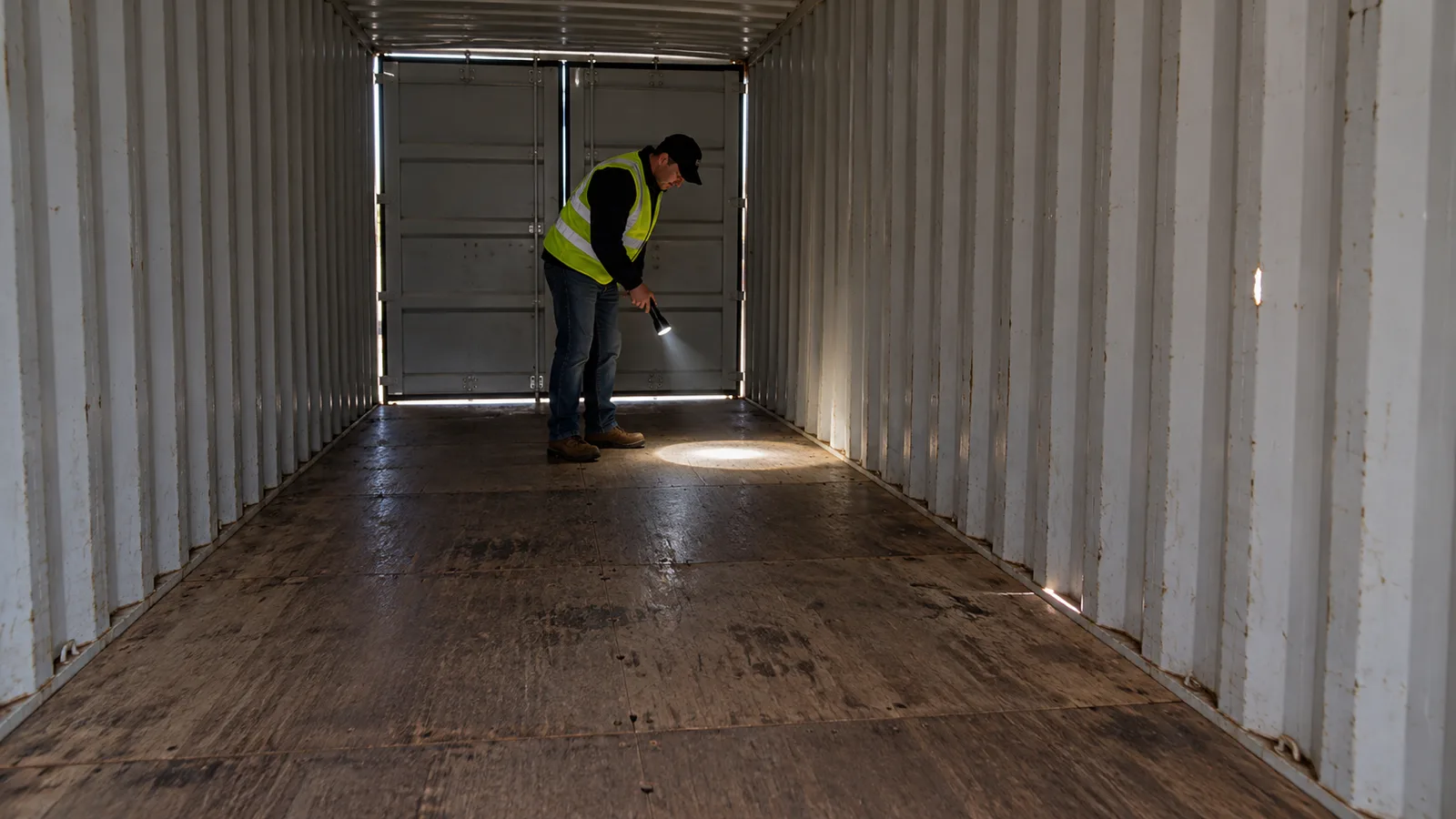
With another person outside and a safe way to reopen the doors, reduce the interior light and look for daylight through the roof, walls, seams, and door perimeter. A bright point or line of light can indicate an opening that may admit water. Do not confuse light from designed vents with damage.
The daylight test is useful but not complete. A seam can leak during wind-driven rain without showing obvious light, and condensation can create moisture even when no rain enters. Look for water tracks, rust streaks, darkened plywood, swollen floor edges, dampness, or recent sealant. Ask whether any leak repairs are included before delivery.
Step 7: Inspect the Floor, Interior Walls, and Odor
Walk the floor methodically and feel for soft, springy, uneven, or broken areas. Check around the doors and wall edges, where water damage can begin. Note patches, deep gouges, oil staining, protruding fasteners, delamination, and areas that differ sharply in color or texture.
Use your nose as well as your eyes. A strong chemical, petroleum, musty, or unexplained odor may be difficult to remove and can make the container unsuitable for sensitive contents or occupied conversions. Do not enter if fumes cause irritation or if the previous cargo and cleaning history are uncertain. Professional assessment may be appropriate for contamination concerns.
For stationary storage, plan around condensation as well as leaks. Steel responds quickly to changing weather, and moisture in the air or stored materials can condense on cold surfaces. Our guide to preventing shipping container condensation explains drainage, ventilation, desiccants, insulation, and operating practices.
Step 8: Review the CSC Plate and Safety Markings
The metal CSC safety approval plate is normally located on the door end. It includes technical information related to the container’s approval and capabilities. The International Maritime Organization’s Safe Containers Convention overview explains that containers used in international transport are safety-approved and periodically examined under the convention.
A plate’s presence by itself does not prove that an older container has a current examination, is accepted by a carrier, or is suitable for the cargo you plan to ship. If the unit will re-enter transport, tell the seller and confirm the examination status, documentation, repair requirements, and carrier or terminal acceptance with the relevant professionals. For stationary storage, the plate can still help identify manufacturing and technical details, but your inspection must focus on present condition and intended use.
Step 9: Evaluate Repairs and Modifications
Repairs are common and are not automatically negative. A properly completed repair can restore function; an improvised patch can hide corrosion or create another leak. Look for clean welds, sealed edges, compatible materials, sound fasteners, and coatings that extend beyond bare metal. Ask whether the repair addressed the cause or only covered the visible symptom.
Previous vents, electrical penetrations, lockboxes, windows, shelving, and wall openings should be inspected as part of the envelope. Confirm whether modifications are included in the quoted condition and whether they suit your intended project. Building, electrical, fire, zoning, or occupancy requirements may apply to a conversion. Those requirements are location- and use-specific, so consult the relevant local authority and qualified trades.
How to Inspect a Container You Cannot Visit
Remote purchasing requires better documentation, not lower standards. Ask for a dated photo and video set of the exact unit, including:
- All four exterior sides and every corner casting
- The complete roof from safe access
- Both doors opening, closing, and locking
- Close-ups of gaskets, hinges, locking gear, and lower rails
- The full floor, wall-to-floor edges, roof interior, and repairs
- A daylight test with the doors controlled safely
- The container number, type markings, and CSC plate
- The underside and crossmembers where safely visible
Request written confirmation that the photographed container is the one assigned to your order. Ask what happens if the delivered unit differs materially from the description and when you must report a problem. A vague promise to supply “something similar” creates avoidable uncertainty when appearance or exact condition matters.
Match the Inspection to Delivery and Placement
A sound container can still become a poor purchase if it cannot be delivered or placed correctly. Before payment, confirm the delivery ZIP code, access width, gate dimensions, surface condition, slope, overhead wires and branches, turn radius, trailer type, unloading method, and desired door orientation.
The placement area should be stable, reasonably level, drained, and accessible for the agreed delivery equipment. Uneven support can twist the frame enough to affect door operation. Review the complete shipping container delivery site preparation checklist before scheduling the truck.
Calculate Total Landed Cost Before Comparing Offers
The lowest container-only figure is not always the lowest completed-project cost. Compare quotations on the same basis:
- Exact size, height, type, and condition
- Whether photos show the exact unit
- Repairs, cleaning, repainting, or lockbox work included
- Delivery distance, equipment, placement assumptions, and waiting time
- Taxes and any site or permit costs
- Foundation or support materials
- Ventilation, insulation, electrical, or other planned modifications
- Written condition terms and issue-reporting process
The U.S. shipping container cost guide explains the variables that affect container and delivery pricing. Use it to compare like with like rather than assuming two similarly sized boxes represent the same value.
Used Shipping Container Walk-Away Warning Signs
Some issues can be repaired, but the repair scope must make sense for the purchase price and project. Pause the transaction or obtain qualified advice when you find:
- A visibly twisted frame or significant corner-post damage
- Cracked, torn, or severely deformed corner castings
- Widespread deep corrosion or holes in structural members
- Doors that cannot be operated or sealed as represented
- Extensive soft flooring, unknown residue, or persistent strong odor
- Large roof depressions that hold water or show active leakage
- Fresh coating over unexplained damage without repair records
- Identification that does not match the paperwork or assigned unit
- Refusal to provide reasonable exact-unit documentation
- A delivery plan that does not fit the access or prepared site
A defect does not always mean “never buy.” It means the issue, remedy, responsibility, cost, and resulting fitness for use should be clear before money changes hands.
What to Put in Writing Before You Buy
A clear order reduces disagreement later. Record the exact container number when selecting a specific unit, its size and type, the stated condition, included repairs, delivery location, unloading method, orientation request, price components, taxes, estimated schedule, and the process for reporting a material condition discrepancy.
If you are buying by grade rather than exact unit, ask what minimum condition standards apply and whether substitutions are allowed. Keep the listing, photographs, messages, quote, invoice, and inspection notes together. Avoid sending payment to an account that cannot be tied to the verified seller, and independently confirm changed payment instructions.
Choose the Container That Fits the Job
A used container does not need to look new to provide practical value. It does need to match the seller’s description and the demands of your project. Inspect the frame before the paint, operate every door, look closely at the roof and lower rails, test the interior, assess the floor and odor, verify the exact unit, and plan delivery before committing.
MS Container Solutions can help U.S. buyers compare available used shipping containers for sale and coordinate a project-specific quotation. Share the desired size, intended use, delivery ZIP code, access conditions, and condition priorities through the shipping container quote request.
Frequently Asked Questions
What should I look for when inspecting a used shipping container?
Check the frame geometry, corner posts and castings, rails, roof, walls, doors, locking gear, gaskets, floor, underside, odor, repairs, identification, and any daylight or water staining inside. Match those findings to the intended use and get the exact unit and condition in writing.
How can I tell whether a shipping container leaks?
With another person present and a safe way to reopen the doors, darken the interior and look for daylight through the roof, walls, seams, and door seals. Also check for water tracks, rust streaks, swollen floor edges, dampness, and failing repair sealant because some leaks may not show obvious daylight.
Is surface rust normal on a used shipping container?
Light surface rust around scratches and hardware is common. Deep pitting, flaking layers, holes, expanding seams, or major metal loss—especially at corner posts, castings, rails, roof seams, and crossmembers—deserves closer evaluation and may require repair.
What does cargo worthy mean on a used container?
Cargo worthy generally describes a container considered structurally suitable for cargo transport at the time of inspection. Ask who inspected it, when, what documentation is included, and whether it meets the requirements of the carrier or transport operation you plan to use.
Can I inspect a used container remotely?
Yes, but request dated photographs and video of the exact numbered unit, including every side, roof, doors operating, gaskets, floor, repairs, underside, markings, and an interior daylight test. Get written confirmation that the documented unit is assigned to your order.
Should I inspect the delivery site before buying the container?
Yes. Confirm access width, gate size, turns, slope, surface condition, overhead clearance, trailer type, unloading method, final supports, and door orientation. Site problems can add cost or prevent the driver from placing the container where intended.